At Achieve, we're committed to providing you with the most accurate, relevant and helpful financial information. While some of our content may include references to products or services we offer, our editorial integrity ensures that our experts’ opinions aren’t influenced by compensation.
Achieve Insights
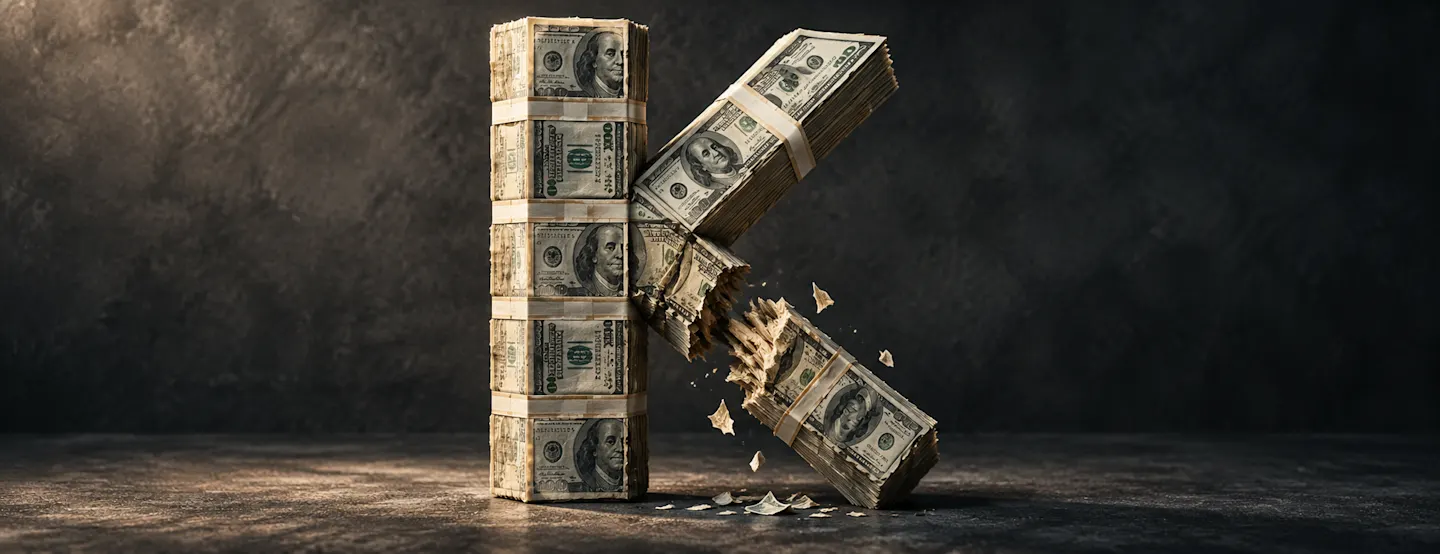
CEO Corner: Look out below—the bottom leg of the“K” is breaking
Oct 15, 2026

Written by
The 7.5% mortgage didn’t cool the housing market. It froze it.
We might be breaking the bottom leg of the K-shaped economy, and I’m not sure the Fed’s actions will even have the desired effect.
This morning’s CPI print makes the case. September came in at 3.7% against a 3.6% consensus. Gasoline rose 9.1% in a single month (and is up 34% year over year), and that one line item accounts for more than half of the monthly CPI increase.. An October hike is back on the table. Inflation has now outpaced wage growth for six straight months, and we are at 66 straight months of inflation running above the Fed’s 2% target.
The math for a lot of Americans just doesn’t add up anymore.
What’s happening
Gas is $4.33 a gallon, vs $3.08 a year ago. Strip out food and energy and you get core at 2.6%, much closer to the Fed’s comfort zone. Economists get to read through the gas spike. Our borrowers, and most Americans, drive through it.
An extra $30 a week at the pump is a card minimum. It’s a slice of the rent. It’s the margin that keeps a debt management plan alive or lets someone make a loan payment. When people ask me where the next wave of missed payments comes from, I don’t point to a Fed white paper. I point to this number, at this pump, right now. The cost of living and the cost of borrowing keep pulling away from what households can afford.
The Fed strips out energy to understand core inflation. A stressed borrower can’t strip out the drive to work.
That same borrower is backed into a corner on housing, locked in what I think of as housing jail. In 10 years the 30-year mortgage rate has gone from 3.4% to 7.5%, and the median home price has gone from $235k to $418k. Assuming a 20% down payment on a 30-year mortgage, the monthly principal-and-interest payment to buy that home has jumped about 180%, from $834 to $2,338.The pain and pressure are very real.
Looking ahead
Here’s what a frozen market looks like from my seat. Owners sitting on 3% mortgages can’t sell, move or refi, because they’d trade a payment they can afford for one they can’t. Buyers can’t buy. Volume dies, but prices don’t correct, because nobody lists and the market freezes.
The pressure doesn’t disappear. It goes into the equity of homeowners and pulls forward future cash flow. HELOC balances have risen 17 straight quarters. Home equity originations are up 20%. Personal loan originations have ripped too, as people dive into consolidation loans, secured or unsecured. The bottom leg of the K is struggling under inflation and a cost of living that is outrunning income gains, so people refinance or consolidate. But the underlying problem stays. Many Americans just can’t keep up.
I’ve watched this movie for more than two decades as co-CEO at Achieve: equity lines grow before delinquency lines do. A HELOC opened to cover the gap between what a family spends and what it earns isn’t a sign of a resilient consumer. It’s a budget being patched. The patch holds until it doesn’t, and then the same families are standing on the equity ladder looking for a way down.
With the 30 year pinned near 7.5% and the Fed possibly hiking into household budgets that are already stretched, I expect the pressure to keep showing up in home equity. Watch the equity, not the listings. That’s where the stressed consumer shows up first.
We try to be disciplined on credit at Achieve, and a multi-product platform lets us point someone to the right tool rather than the one we happen to sell. Not every lender has that discipline, and inflation this hot makes it tempting to push borrowers into loans that get riskier every quarter.
Fed policy
Will more hikes even fix the underlying problem? Is today’s economy the same one the Fed governors wrote their doctoral theses on?
There’s a real argument that higher rates won’t lower inflation, and may make things worse.
Data center and AI investment won’t slow because rates are a bit higher. It’s being financed with long-term equity capital, and it will keep crowding out other investment and pushing rates up.
Government spending, budget deficits and record federal debt is a root cause that only gets worse when the cost of financing that debt rises (it can spiral into a vicious cycle).
Energy is inelastic, and right now it’s elevated by war-driven supply shocks, not by interest rates.
Higher rates hurt housing, energy, autos and other capital-intensive industries, which is exactly where we need more supply. Prices in those sectors don’t come down.
Mostly, we’re a different economy than the one the textbooks and models were built on. The U.S. is now dominated by services, manufactures far less, and responds less to rate hikes than it used to.
What can we do
There are solutions. They’re hard policy choices, and they require caring more about American families than about political points.
Stop the forever wars. Conflicts that disrupt global trade, spike commodity costs and sacrifice family budgets for political gain are hurting the economy.
Make student loans dischargeable in bankruptcy. Don’t let college-educated families get dragged into forever debt.
Disclose the risk of higher education. Debt-funded education should carry a cigarette-style warning on the ROI of that decision. At 18, you could be signing up for permanent debt.
Fix healthcare. It’s overregulated and built on the wrong incentives. If benefit costs keep rising at 3x to 5x the pace of economic growth, thousands of small businesses will go under.
Lean back into globalization. Done responsibly, of course. Global trade is a deflationary force and drives expansion, and we’re heading the other way and pushing industries off a cliff and prices higher.
Build affordable housing. Remove red tape and invest in affordable housing for young and growing families. This is win-win for cities, families, builders and the economy.
Care. Listen to Main Street. Look at what we’re doing to everyday Americans. Lift them up, lower their costs and promote growth.
That bottom leg of the K could break, and when it does it will hurt the economy and society far more broadly. Don’t look through it when you evaluate core inflation. Look straight at what’s best for everyday Americans.
Author Information
Written by
Co-CEO and Co-Founder
Related Articles

Americans in their 20s and 30s are becoming seriously delinquent on their credit cards at a faster pace than before the pandemic and approaching levels not seen since the Great Recession.


On the surface, the premise of Buy Now, Pay Later is simple and appealing. But borrowers who can’t afford to repay their BNPL loans risk getting hit with late fees, falling behind on other financial obligations, damaging their credit and other challenges.

With financial volatility on the rise, it’s time to rethink how people use mobile apps to manage their money
Americans in their 20s and 30s are becoming seriously delinquent on their credit cards at a faster pace than before the pandemic and approaching levels not seen since the Great Recession.
On the surface, the premise of Buy Now, Pay Later is simple and appealing. But borrowers who can’t afford to repay their BNPL loans risk getting hit with late fees, falling behind on other financial obligations, damaging their credit and other challenges.
With financial volatility on the rise, it’s time to rethink how people use mobile apps to manage their money