
At Achieve, we're committed to providing you with the most accurate, relevant and helpful financial information. While some of our content may include references to products or services we offer, our editorial integrity ensures that our experts’ opinions aren’t influenced by compensation.
Debt Consolidation
The auto loan hangover: the true cost of ownership
Sep 16, 2026

Written by

Reviewed by
Key takeaways:
Survey respondents with a car payment spend nearly $920 a month to keep a car on the road, once loan, insurance, gas, repairs, and fees are counted.
Nearly 3 in 10 owners with a car loan (29%) owe more on their vehicle than it is worth.
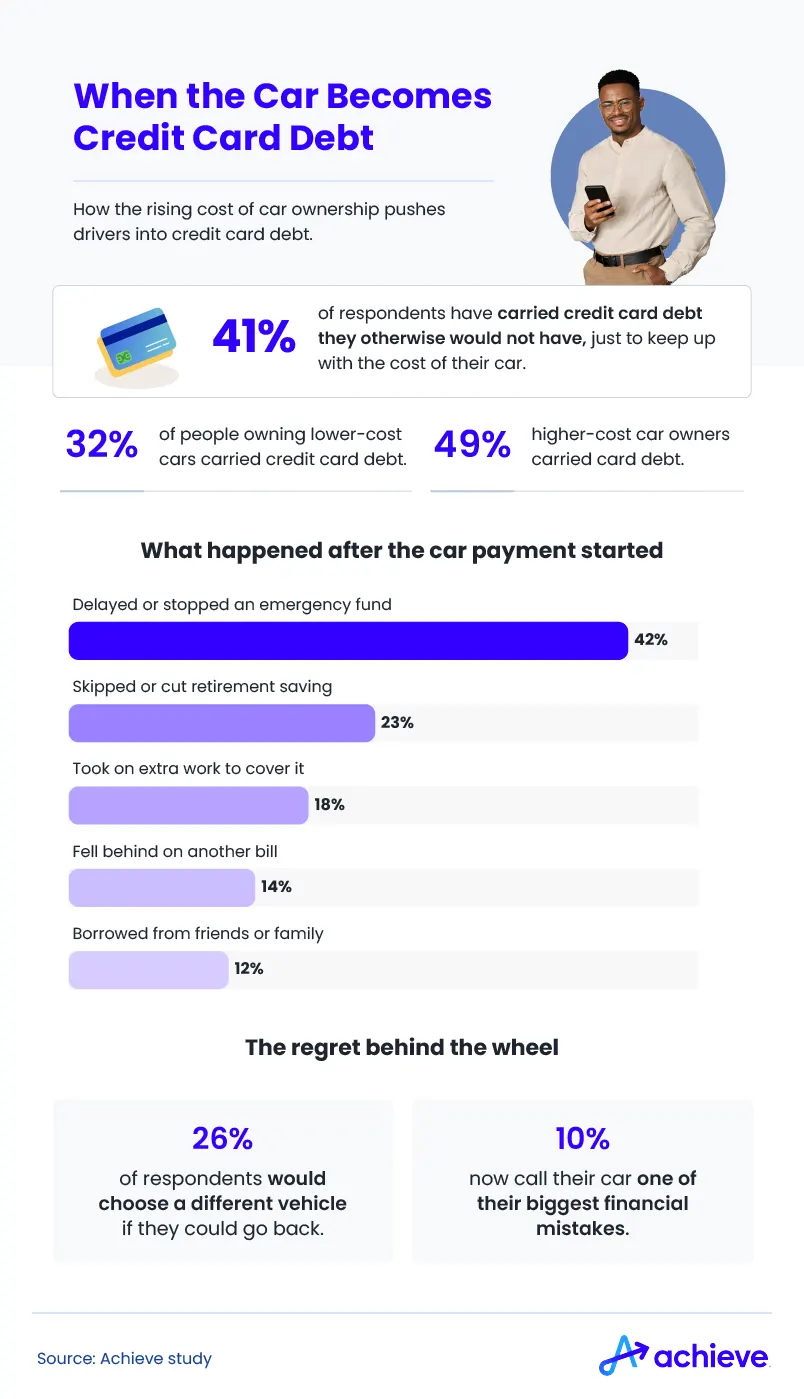
Over 2 in 5 survey respondents (41%) have carried credit card debt they otherwise would not have, just to keep up with their car.
Nearly 1 in 3 (30%) admit they spent more on their car than they could comfortably afford.
About 1 in 4 (26%) would choose a different vehicle if they could go back.
The payment on the loan is only the first slice of what a car costs. Once insurance, gas, repairs, registration, and assorted fees are added in, the average American with a car payment spends about $920 a month to keep a vehicle on the road.
Achieve surveyed 1,005 U.S. adults who own or drive a car to learn what ownership really costs and how it fits into the rest of their finances. The results show a gap between the monthly payment people plan for and the all-in price they actually pay, along with practical lessons for anyone budgeting for their next vehicle.
The true cost of keeping a car on the road
The real expense of a vehicle shows up long after the paperwork is signed, spread across a handful of recurring monthly bills.
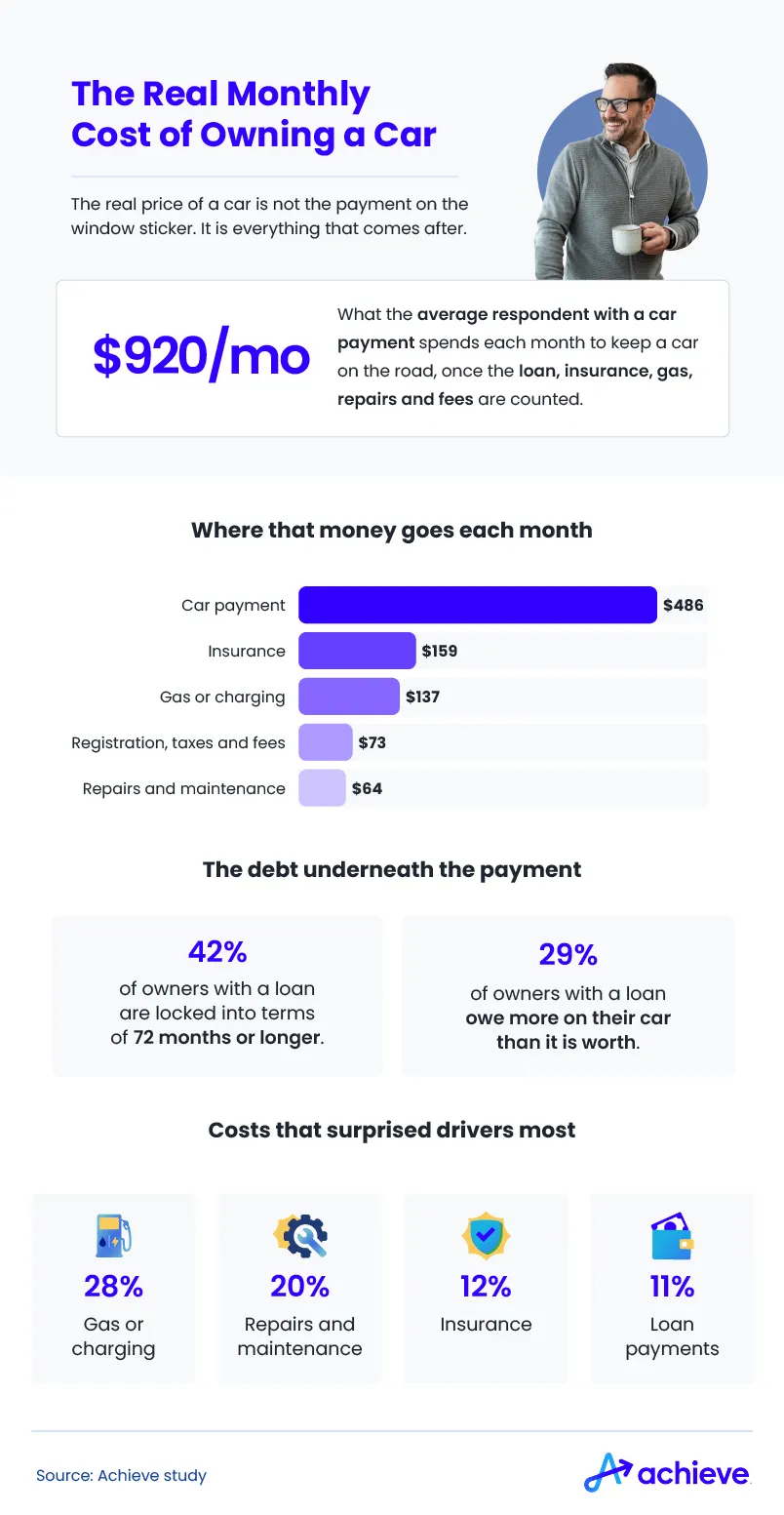
Among drivers with a car payment, the all-in cost of ownership averaged about $919 a month. The loan itself accounted for $486 of that, followed by $159 for insurance, $137 for gas or charging, $73 for registration, taxes, and fees, and $64 for repairs and maintenance. Gas was the line that caught the most people off guard, with 25% naming it the cost that surprised them most.
That monthly bill held fairly steady across generations, at $941 for Gen Z, $932 for millennials, and $902 for Gen X. What varied more was the debt. Over 2 in 5 owners with a loan (42%) were locked into terms of 72 months or longer, and nearly 3 in 10 (29%) owed more on their vehicle than it was worth.
When the payment puts the rest of life on hold
For some drivers, the cost of the car reaches beyond the driveway and into savings and longer-term plans.
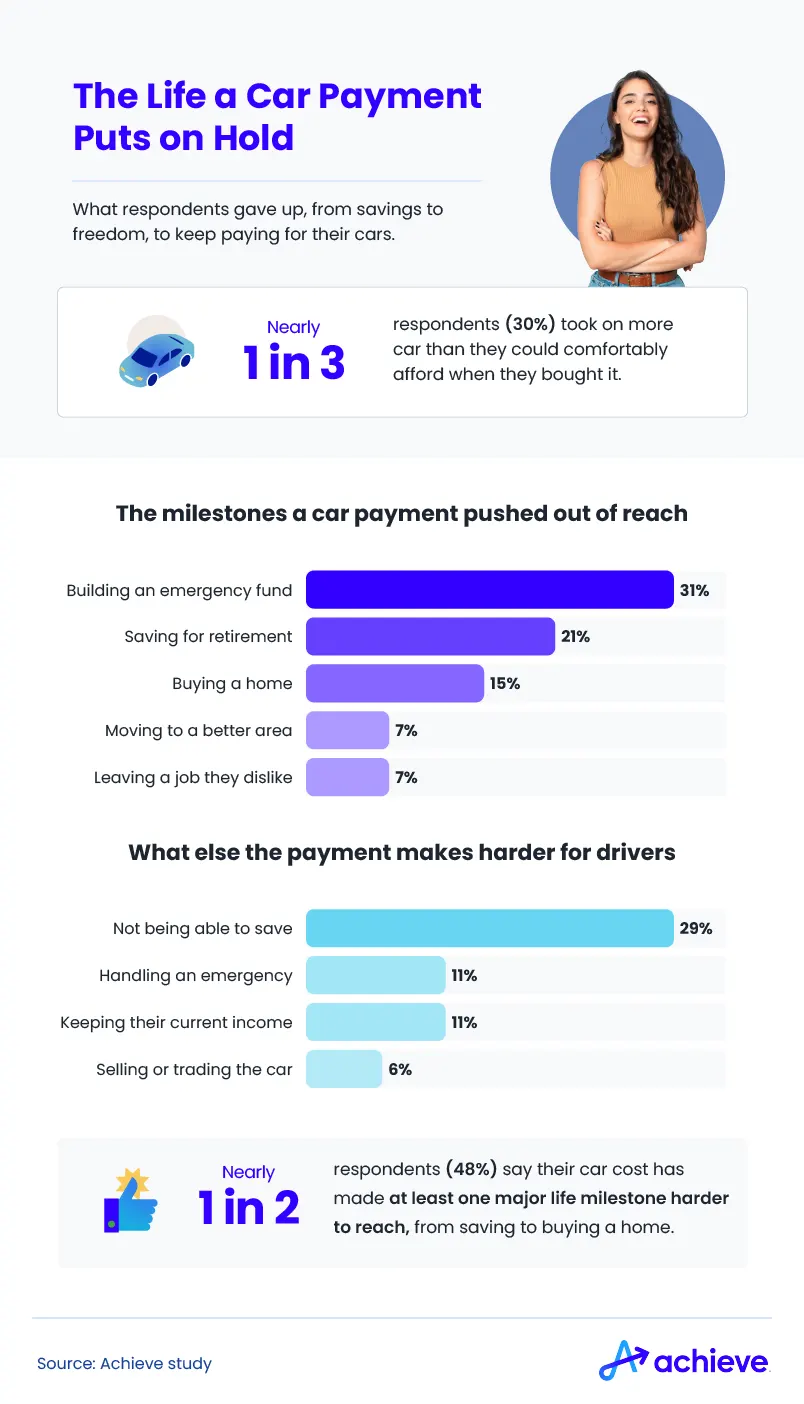
Most owners bought within their means, though nearly 1 in 3 (30%) said they took on more car than they could comfortably afford at the time of purchase. Younger drivers felt it most, at 38% of Gen Z and 33% of millennials, compared with 23% of Gen X and 20% of baby boomers, and renters were more likely than homeowners to have stretched, at 35% versus 27%.
The cost touched bigger plans, too. About half of owners said their car hadn't slowed them down, while nearly as many (48%) said it has made at least one major milestone harder to reach, a share that rose to 60% among Gen Z. Building an emergency fund was the goal most often set aside (31%), followed by saving for retirement (21%) and buying a home (15%).
When car costs turn into credit card debt
When the monthly total outpaced the budget, many drivers turned to credit cards and other stopgaps to stay
current.
For some households, the monthly total outpaced the budget, and drivers turned to credit cards or other short-term fixes to stay current. Over 2 in 5 (41%) took on credit card debt they otherwise wouldn't have to keep up with the cost of their car. For drivers already carrying that kind of balance, debt consolidation can roll multiple card payments into one and make the payoff more manageable. Keeping up showed up elsewhere too: 42% delayed or paused building an emergency fund, 23% cut back on retirement saving, 18% picked up extra work, 14% fell behind on another bill, and 12% borrowed from friends or family.
Most drivers were content with their vehicle looking back, but a notable share had second thoughts. About 1 in 4 (26%) said they would choose a different vehicle if they could go back, a number that rose to 32% among Gen Z, and about 1 in 10 (10%) counted their car among their biggest financial mistakes. For anyone focused on clearing that balance, an app for getting out of debt can help map a payoff plan.
Getting ahead of the real cost of car ownership
The purchase price rarely tells the whole story. Insurance, fuel, upkeep, and longer loan terms can turn a manageable-looking cost into a bigger monthly commitment than expected. A little planning goes a long way. A free budgeting app makes it easier to add up the full monthly cost before signing, keep the loan term as short as you comfortably can, and leave room for the expenses that tend to catch owners off guard. With a clear picture of the true cost up front, a car can get you where you're going without crowding out the goals waiting down the road.
Methodology
Achieve surveyed 1,005 U.S. adults who own or drive a car to understand the true all-in cost of car ownership and how it affects the rest of their financial lives. The average age of respondents was 43. The gender breakdown was 60% women, 39% men, and 1% who preferred not to say or self-described. Millennials made up the largest share of respondents (49%), followed by Gen X (25%), Gen Z (15%), and baby boomers (10%). The survey was conducted online in July 2026. For brand-level breakdowns, only brands with at least 20 respondents who carry a car payment were included, and figures reflect all-in monthly cost among those owners. Brands below that threshold were excluded, so the ranking reflects the most commonly financed vehicles rather than the full market. Figures may not sum to 100% due to rounding
About Achieve
Achieve is a digital personal finance company that helps people work toward financial freedom through debt consolidation loans, personal loans, and home equity lending, along with free tools and financial education. Achieve offers programs for people juggling multiple debts, such as high-interest credit card debt on top of a car loan, who want a clear path to a better financial life. You can learn more about Achieve's debt solutions and financial resources to find out which options fit your situation.
Fair use statement
Share this content
<a href="https://www.achieve.com/learn/debt-consolidation/the-auto-loan-hangover" target="_blank" rel="noopener">The auto loan hangover: the true cost of ownership</a>
Author Information
Written by
Rebecca is a senior contributing writer and debt expert. She's a Certified Educator in Personal Finance and a banking expert for Forbes Advisor. In addition to writing for online publications, Rebecca owns a personal finance website dedicated to teaching women how to take control of their money.
Reviewed by
Kimberly is Achieve’s senior editor. She is a financial counselor accredited by the Association for Financial Counseling & Planning Education®, and a mortgage expert for The Motley Fool. She owns and manages a 350-writer content agency.
Related Articles

Debt consolidation can help you pay off what you owe, but it isn't the only way to resolve the debt. Learn more here.

Paying off multiple high-interest credit cards at the same time can be expensive and daunting. We show you how online debt consolidation can help.


If you have high credit card debt, debt consolidation may be able to help you lower your monthly payments. Here’s how.
Debt consolidation can help you pay off what you owe, but it isn't the only way to resolve the debt. Learn more here.
Paying off multiple high-interest credit cards at the same time can be expensive and daunting. We show you how online debt consolidation can help.
If you have high credit card debt, debt consolidation may be able to help you lower your monthly payments. Here’s how.