
At Achieve, we're committed to providing you with the most accurate, relevant and helpful financial information. While some of our content may include references to products or services we offer, our editorial integrity ensures that our experts’ opinions aren’t influenced by compensation.
Debt Consolidation
Using home equity to pay off debt: how much homeowners could save
Sep 16, 2026

Written by

Reviewed by
Key takeaways:
Connecticut homeowners have the most to gain, up to $1,676 a year, by moving credit card debt to a home equity line, vs. $838 in Mississippi.
31% of homeowners didn't know they could use home equity to pay off credit card debt.
42% consider borrowing against home equity as riskier than carrying a credit card balance at around 21% interest.
54% of homeowners would rather leave their home equity untouched than use it, even if it means paying more in card interest.
Homeowners who carry a credit card balance lose an average of $1,197 a year in interest they could avoid by using the equity in their home to pay off those cards. A new Achieve analysis compares a typical credit card interest rate with a home equity line of credit (HELOC) rate to calculate the potential savings for homeowners who carry revolving credit card debt.
Achieve surveyed 1,036 U.S. homeowners about their knowledge of home equity and their opinions on borrowing against their homes. Whether you're paying down credit card balances or exploring your borrowing options, these findings may help you better understand the potential costs, benefits, and common misconceptions surrounding using home equity to pay off debt.
Potential interest savings vary widely by state
To show how borrowing costs can differ, we compared the average credit card interest rate with the average HELOC rate. As of mid-2026, the average homeowner carrying a credit card balance paid a rate of 22.15%. The average HELOC rate, for those who qualify, was nearly 7.5%. The estimates are hypothetical and do not assume every homeowner would qualify for a HELOC or receive the average rate.
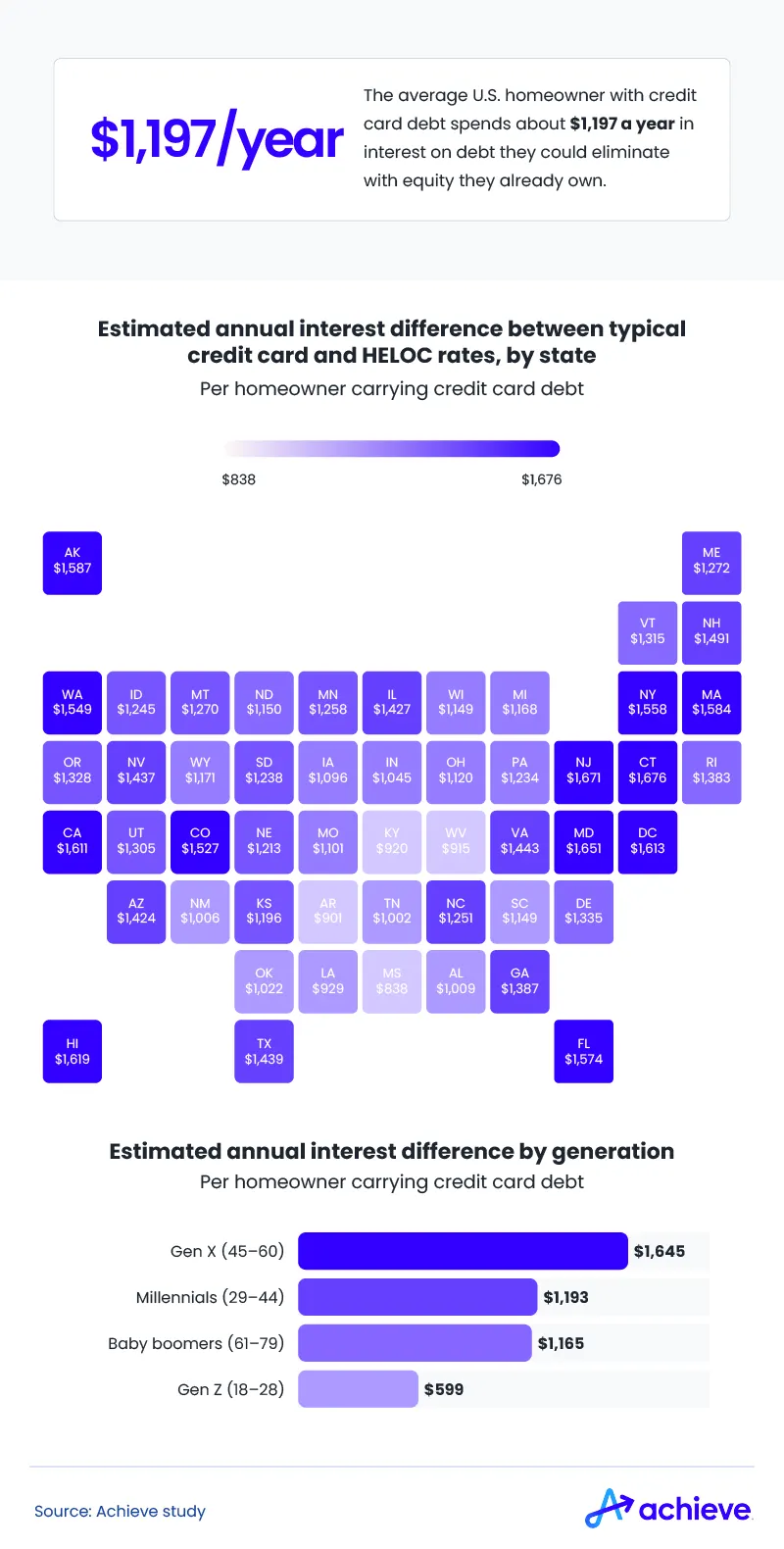
Connecticut had the largest estimated annual interest difference of any state, at $1,676 per homeowner carrying a credit card balance. Mississippi had the smallest, at $838. The highest estimated annual interest differences were found in:
Connecticut: $1,676
New Jersey: $1,671
Maryland: $1,651
Hawaii: $1,619
District of Columbia: $1,613
California: $1,611
Alaska: $1,587
Massachusetts: $1,584
Florida: $1,574
New York: $1,558
The 10 states with the lowest estimated annual interest differences were:
Mississippi: $838
Arkansas: $901
West Virginia: $915
Kentucky: $920
Louisiana: $929
Tennessee: $1,002
New Mexico: $1,006
Alabama: $1,009
Oklahoma: $1,022
Indiana: $1,045
By generation, Gen X homeowners had the largest estimated annual interest difference, at $1,645, compared with $1,193 for millennials, $1,165 for baby boomers, and $599 for Gen Z.
Most homeowners keep their equity untouched
Even homeowners who feel the pinch of high-interest debt are reluctant to tap into what they've built up in their homes.
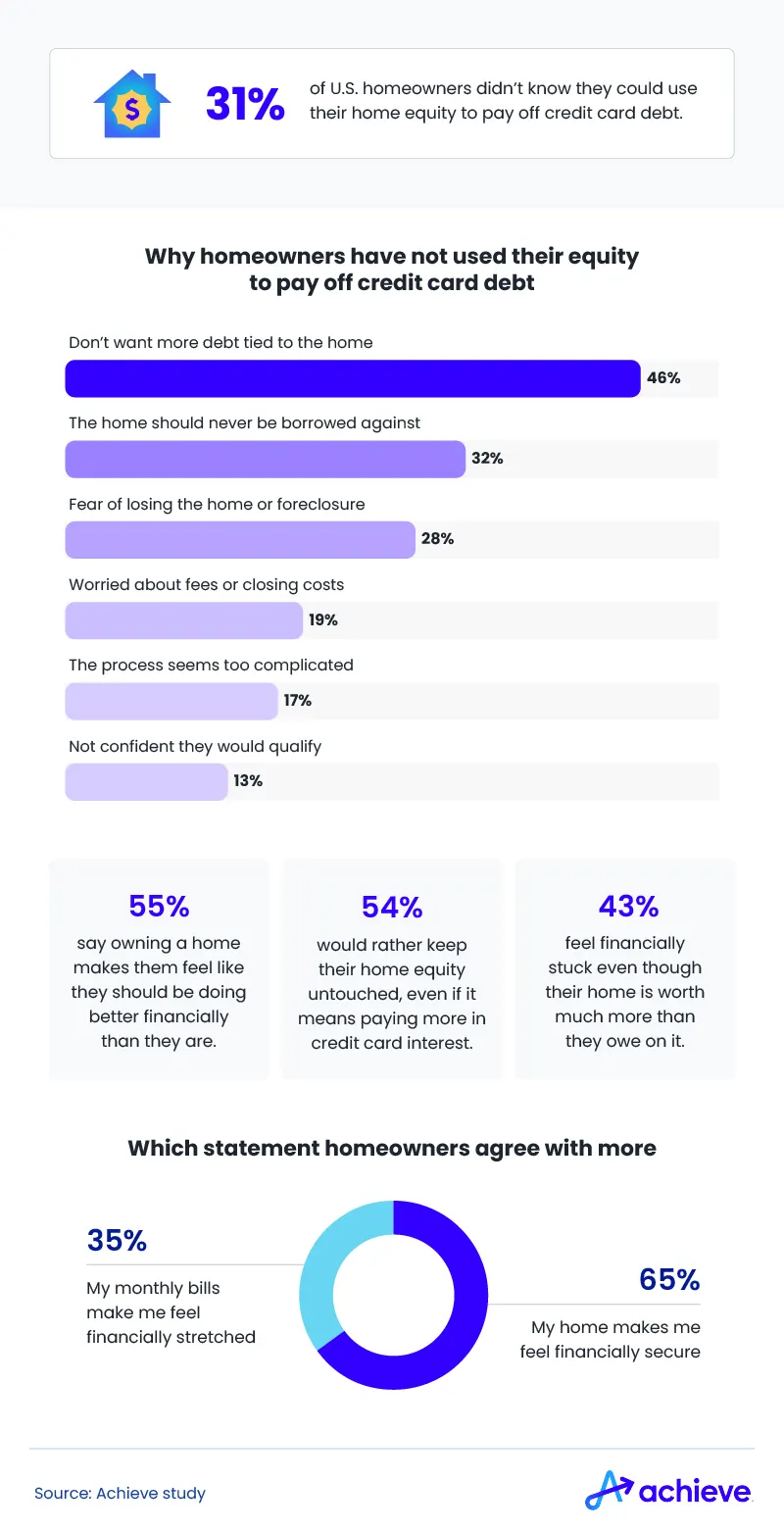
About a third of survey respondents (31%) said they didn't know that home equity could be used to pay off credit card debt. Gen Z homeowners were less likely to know (60%) than millennials (38%), Gen X (21%), and baby boomers (18%).
Respondents who understood the option still hesitated: 42% felt that using their home as collateral was riskier than carrying a card balance at around 21% interest. Another 54% said they'd rather leave their equity untouched than use it, even if it means paying more in interest. That reluctance was strongest among Gen Z (61%).
When asked what had stopped them from using their equity, almost half (46%) said they don't want more debt tied to their home, 32% thought a home should never be borrowed against, and 28% cited fear of losing the home to foreclosure. Smaller shares were worried about fees or closing costs (19%), found the process too complicated (17%), and had doubts about whether they'd qualify (13%).
The math changes minds
Many homeowners want to know how much they'd save if they used their home equity to pay off debt, but they also want someone credible to walk them through what those numbers mean.
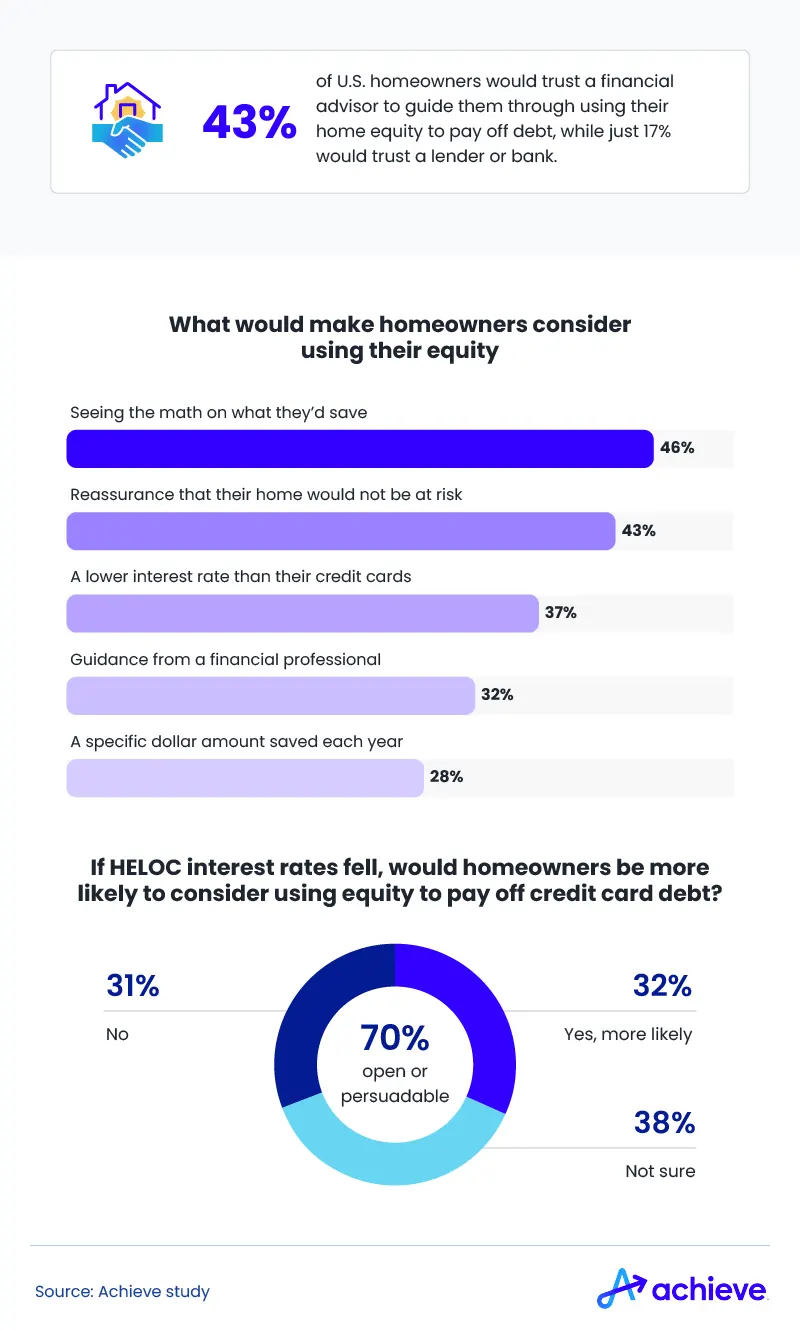
Nearly half of respondents (46%) said they'd seriously consider using their equity to pay off credit card debt if someone simply showed them the math on what they'd save. Reassurance ranked close behind, with 43% wanting confirmation that their home wouldn't be at risk. Others wanted a lower rate than their credit cards (37%) and guidance from a financial professional (32%).
Survey respondents said they'd trust financial advisors to help them use their equity far more often than lenders or banks (43% vs. 17%). Meanwhile, 56% agreed their home equity feels like money they could only access by selling the house, but 52% agreed that losing thousands of dollars a year to card interest while sitting on that equity would be a financial mistake.
Falling rates could close some of that gap. Asked whether lower HELOC rates in 2026 would make them more likely to consider the switch, 32% said yes, and 38% said they weren't sure, putting 70% in the open-or-persuadable camp. Only 31% ruled it out entirely.
A smarter way to think about your debt
Many homeowners have built up valuable equity while also carrying expensive credit card debt. This research suggests the biggest barrier isn't always the numbers themselves, but uncertainty about the options and the risks involved. Taking the time to understand both may help you make a more informed decision about your next financial step.
Achieve helps homeowners understand the full picture, not just a single solution. Achieve compares your options and shows how they could affect your monthly payments, long-term costs, and financial goals, so you can choose a path that fits your situation with confidence.
Methodology
Achieve surveyed 1,036 U.S. homeowners about the credit card debt they carry and their attitudes toward using home equity to pay it off. Respondents were distributed across genders and generations. The gender breakdown was women (55%) and men (44%), with the remainder non-binary or preferring not to answer. The generational breakdown included millennials (46%), Gen X (32%), baby boomers (14%), and Gen Z (7%). All respondents were homeowners, with 73% owning their home with a mortgage balance and 27% owning it outright. The survey was conducted in July 2026. All percentages are rounded to the nearest whole number.
To complement the survey, we combined several public datasets to estimate the annual interest difference between carrying credit card debt at the average credit card APR and financing the same balance at the average HELOC rate. The calculation applies the 14.7-percentage-point gap between the average credit card APR (22.15%, Federal Reserve G.19, Q2 2026) and the average HELOC rate (approximately 7.5%, Bankrate, July 2026) to carried credit card balances. These estimates do not assume that every homeowner would qualify for a HELOC or receive the average rate. Figures represent homeowners who carry a credit card balance, not all homeowners.
The national figure applies the differential to the average balance carried by homeowners with card debt, derived from the Federal Reserve Survey of Consumer Finances (2022), adjusted to more recent balance levels using Experian data. State and generational figures apply the same calculation to published average balances by state (LendingTree, Q3 2025) and by generation (Experian, June 2025), scaled to a homeowner basis. All dollar figures are rounded to the nearest whole number. Data as of mid-2026.
About Achieve
The study was conducted by Achieve.com, a digital personal finance company that helps people take control of their finances through solutions like personal loans, home equity loans (HELOC), and debt consolidation programs.
Fair use statement
Share this content
<a href="https://www.achieve.com/learn/debt-consolidation/using-home-equity-to-pay-off-debt" target="_blank" rel="noopener">Using home equity to pay off debt: how much homeowners could save</a>
Author Information
Written by
Rebecca is a senior contributing writer and debt expert. She's a Certified Educator in Personal Finance and a banking expert for Forbes Advisor. In addition to writing for online publications, Rebecca owns a personal finance website dedicated to teaching women how to take control of their money.
Reviewed by
Kimberly is Achieve’s senior editor. She is a financial counselor accredited by the Association for Financial Counseling & Planning Education®, and a mortgage expert for The Motley Fool. She owns and manages a 350-writer content agency.
Frequently asked questions about using home equity to pay off debt
Whether it’s smart to use home equity to pay off debt depends on the numbers and who's helping check them. A home equity loan or HELOC usually carries a lower interest rate than a card balance sitting near 21%, which is why 46% of survey respondents said they'd seriously consider the switch once they saw the actual savings. A second opinion helps, since respondents trust a financial advisor (43%) far more than a lender or bank (17%) to walk them through the decision.
The real cost of a $50,000 home equity loan depends on the rate, and the loan term. For example, a 20-year term at a 7.5% fixed rate would put your payment at about $403 per month. A fixed interest rate loan keeps the payment predictable for the life of the loan, while a variable interest rate loan fluctuates with the market. Lenders also weigh your credit score alongside your loan-to-value ratio, how much you owe compared with what your home is worth, when setting your rate and terms. Achieve's debt payoff calculator helps you run the numbers against your specific balance and rate.
You can choose from several strategies to pay off $30,000 in a year. Most homeowners get there with a mix of a larger monthly payment, a lower interest rate through options like debt consolidation loans, and closer tracking of where the money goes. A free budgeting app like MoLO could help spot room in a monthly budget, and a tool like Achieve's GOOD app may help track progress as balances go down. For homeowners with equity to work with, moving high-rate credit card debt to a lower-rate home equity loan is one of the more direct ways to speed up that process.
Related Articles

Debt consolidation can help you pay off what you owe, but it isn't the only way to resolve the debt. Learn more here.

Paying off multiple high-interest credit cards at the same time can be expensive and daunting. We show you how online debt consolidation can help.


If you have high credit card debt, debt consolidation may be able to help you lower your monthly payments. Here’s how.
Debt consolidation can help you pay off what you owe, but it isn't the only way to resolve the debt. Learn more here.
Paying off multiple high-interest credit cards at the same time can be expensive and daunting. We show you how online debt consolidation can help.
If you have high credit card debt, debt consolidation may be able to help you lower your monthly payments. Here’s how.