
At Achieve, we're committed to providing you with the most accurate, relevant and helpful financial information. While some of our content may include references to products or services we offer, our editorial integrity ensures that our experts’ opinions aren’t influenced by compensation.
Personal Loans
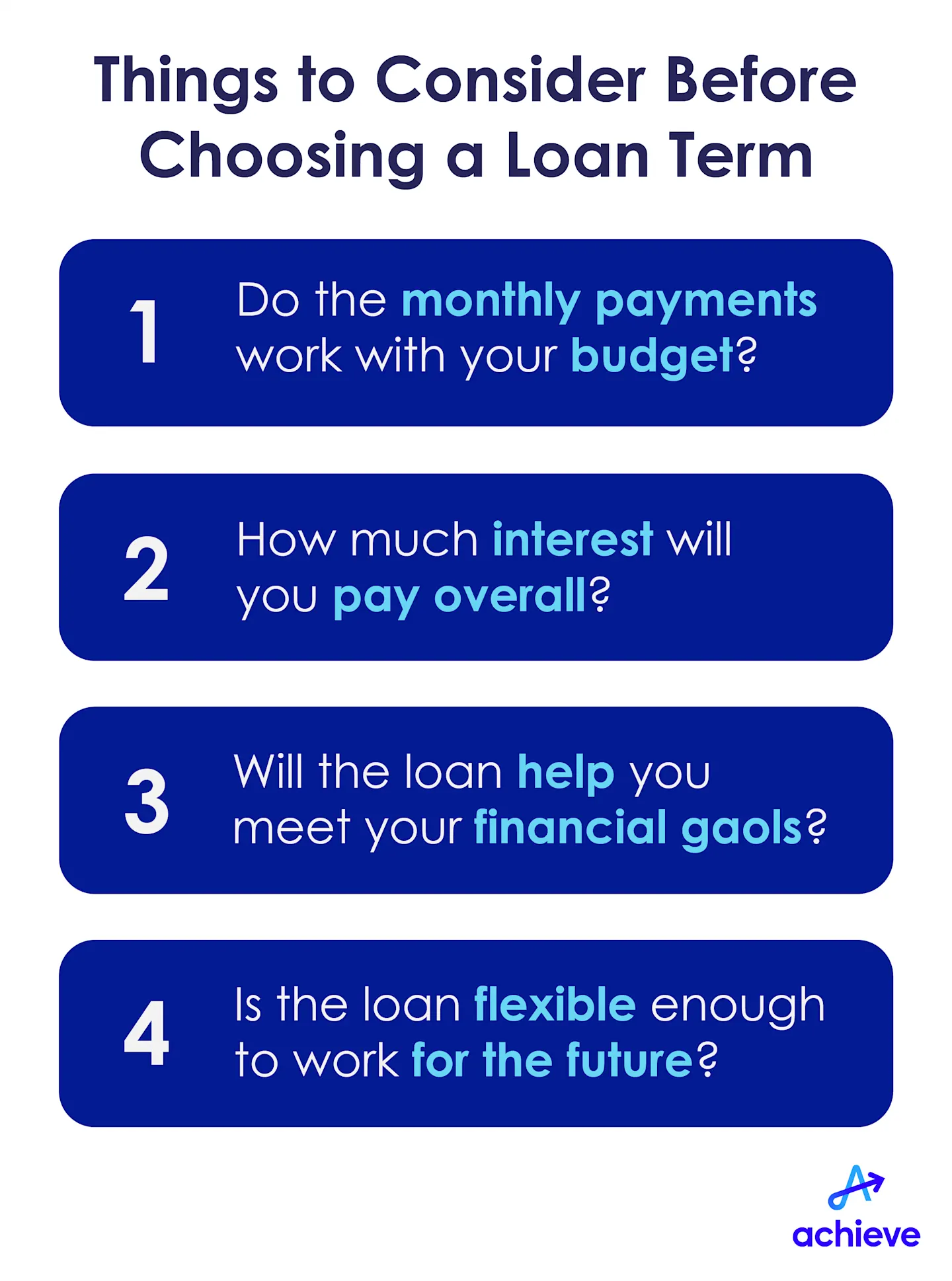
4 things to consider before choosing your loan term
Updated Oct 15, 2026

Written by

Reviewed by
Key takeaways:
Start with how much you can afford to pay monthly.
Longer terms generally have smaller monthly payments.
Shorter terms could help you save on interest costs.
Choosing a personal loan term can feel confusing. You want payments you can handle and a rate that doesn't add extra stress, but sometimes those goals pull in different directions.
When you understand how each part of a loan affects your budget, it becomes much easier to choose a term that supports your goals and keeps your payments manageable. Your ideal loan term is the one that works for you and your goals.
The right loan term isn't one-size-fits-all. Your choice should come down to the costs and your own circumstances.
How do I choose the best personal loan term?
Your loan term is how long you have to repay your balance. A five-year term means you make 60 monthly payments, or one a month for five years. Personal loan terms commonly run about two to seven years.
To choose the right term, start with what fits your budget and goals. Shorter terms tend to cost less in total interest, with higher monthly payments. Longer terms can be easier month-to-month, but they have a higher total cost.
Not sure where to start? We'll walk you through a simple, four-step checklist that could point you in the right direction.
1. Your monthly budget
Start by calculating what you can comfortably afford each month. If you know you could only comfortably pay $200 a month, then you’ll be able to quickly say no to loans with higher monthly payment requirements.
To get a monthly payment that fits your budget, you might need to choose a longer loan term. For instance, say you need to borrow $5,000 and can get a 12% APR. The monthly payment might be $236 if you get a two-year term, but it could drop to $166 a month if you extend it to a three-year term.
You'll typically make two concessions for lower monthly payments.
Your loan sticks around longer.
Longer loans often cost more thanks to additional interest (see the next section).
Be realistic about what you can afford. One easy way to figure this out is to write down how much money you have coming in vs. how much goes out. Try a simple two-column budget, with one column for income and the other for expenses.
Another way to gauge what you can afford is to consider your debt-to-income (DTI) ratio. This compares your monthly debt payments, including rent or mortgage costs, to your gross (pre-tax) monthly income. If those monthly payments add up to $300 and your monthly income is $1,000 before taxes, your DTI is 30%. A lower DTI generally makes it easier to handle unplanned bills.
2. Your total interest cost
Longer loan terms are often more expensive because of the extra interest. Even an extra year of payments could add up to a significant amount of interest. For that reason, you might not accept the longest terms offered to you. We'll illustrate just how quickly interest can add up.
Say you borrow $1,000 at a 12% rate. Here's what the payments and interest could look like for various loan terms:
Term | Monthly payment | Interest cost (total) |
2 years | $47.07 | $129.76 |
3 years | $33.00 | $195.72 |
5 years | $22.00 | $334.67 |
With the longest term, you'd pay $1,334.67 for a $1,000 loan.
In general, you want to keep interest costs as low as possible. The trick is to balance shorter terms with affordable monthly payments. Start with the monthly payments—what you can afford to comfortably pay on a regular basis—and then work from there.
Many lenders will let you pay extra on your loan without charging you a prepayment fee. This option gives you the flexibility to pay off your loan early if your situation improves. Extra payments to your principal could shrink your total interest cost.
Pro tip: Call your loan servicer and tell them you want your extra payments to service the loan principal.
Does the term of my personal loan affect the interest rate?
Yes, loans with shorter repayment terms often come with lower interest rates than longer-term loans. That's because lenders consider shorter terms to be less risky. The longer you need to repay your loan, the more time for things to go wrong and the riskier the lender could consider the loan. Higher risk typically means higher rates.
3. Your financial goals
Think about your loan term options in the context of your financial goals. That might be debt consolidation, credit building, or home improvement.
Two questions to ask:
What loan term is best for my financial goals?
Which loan term will help me become debt-free?
If you're consolidating debt, you might prefer a longer term that keeps your payments low so you can work on getting your finances back on track.
Focused on building credit? You might prefer a shorter term that costs you less interest as you work to build up your credit score with on-time payments.
Spend some time on these questions. The more you pin down your answers, the better you'll understand how to best reach your financial goals.
Achieve is not a Credit Repair Organization and does not provide, or offer, services or advice to repair, modify, or improve your credit.
4. Your future plans
Life's uncertain, and things change. Maybe the Federal Reserve lowers interest rates, giving you an opportunity to refinance your personal loan. Your kid breaks a leg, and you've got an unexpected medical bill.
Longer loan terms could give you more flexibility, since the typically lower payments could free up cash for other things, like tackling surprise expenses. Over the life of your longer term, though, you'll pay more in interest.
A shorter loan term typically means you pay off your loan faster and at a lower cost. The money you save on interest could help you save for emergencies, while the shorter term means you're free of your loan debt sooner and can focus on other financial goals.
When it comes to choosing a loan term, you want one that fits into your life. Choose the option that best suits your needs—now and in the future.
Shorter vs. longer term loans at a glance
What typically changes | Shorter term | Longer term |
Monthly payment | Higher each month | Lower each month |
Total interest | Less over the life of the loan | More over the life of the loan |
Time in debt | Debt-free sooner | Longer repayment |
Budget flexibility | Less room in your monthly budget | More room in your monthly budget |
The right term comes down to your budget and comfort level, not a single best answer.
What's next: Choose your term with confidence
There's no wrong choice. Your financial life is yours alone, so choose the term that fits your budget and your goals. You can't know exactly how your finances will unfold down the road, so it helps to take out a loan thoughtfully. Jot down some of your thoughts to make sure you understand:
The terms
What you can realistically afford
How the loan might fit into your life if your income, expenses, or priorities shift
You're not expected to predict the future, just to make a careful, informed choice today that won't box you in tomorrow.
You could take some of the uncertainty out of the decision by prequalifying for loans with lenders that use a soft inquiry. A soft credit inquiry doesn't impact your credit score, so you can check estimated offers from multiple lenders without hurting your credit. You can compare:
Rates
Terms
How different terms affect loan payments and total interest
Get started with a quick quote on your personal loan options, and bring your checklist. That way you'll have the information you need to choose loans that help you meet your goals.
Author Information
Written by
Cole is a financial writer. He’s written hundreds of useful articles on money for major personal finance publications. He breaks down complicated topics, like how credit cards work and which brokerage apps are the best, so that they’re easy to understand.
Reviewed by
Maurie Backman is a veteran personal finance writer. Her coverage areas include retirement, investing, real estate, and credit and debt management.
Frequently asked questions about 4 things to consider before choosing your loan term
Most personal loan terms are between two to seven years. Each lender decides on its own range of term options, and what's available may vary based on loan use and size. You can ask each lender which term lengths they offer before you apply. Then, use an online calculator to see how the term options impact your monthly payment and total cost.
Some lenders charge a prepayment penalty and some don't, so read your loan agreement before you pay ahead. A prepayment penalty is a fee for paying off your loan early, and the agreement spells out whether one applies and how much it costs.
When your loan has no penalty, you can make extra loan payments whenever you have spare cash so you can pay off your loan sooner. Extra payments can also lower your total interest.
No, you generally can't change a personal loan's term once you sign. You could refinance into a new loan with a different term if your situation changes. Refinancing means you take out a new loan to pay off the current one, then repay the new loan on its own terms. People often refinance when they want a rate or a monthly payment that works better for their budget. A new loan comes with its own application and approval (and potentially new fees), so the terms you're offered depend on your full financial picture at that time.
Related Articles

Adding a co-signer to a personal loan application could improve your approval odds and rate. Learn what lenders look for and how to apply with Achieve.


Learn how unsecured personal loans work, compare rates and terms to credit cards, and find out how to qualify — even with fair credit. Apply today.

Learn how to pay off credit card debt with a personal loan. Compare rates, lower your monthly payments, and get a plan to become debt-free faster.

Adding a co-signer to a personal loan application could improve your approval odds and rate. Learn what lenders look for and how to apply with Achieve.
Learn how unsecured personal loans work, compare rates and terms to credit cards, and find out how to qualify — even with fair credit. Apply today.
Learn how to pay off credit card debt with a personal loan. Compare rates, lower your monthly payments, and get a plan to become debt-free faster.