
At Achieve, we're committed to providing you with the most accurate, relevant and helpful financial information. While some of our content may include references to products or services we offer, our editorial integrity ensures that our experts’ opinions aren’t influenced by compensation.
Personal Loans
Prequalification vs. preapproval
Updated Sep 30, 2026

Written by

Reviewed by
Key takeaways:
During prequalification, you provide a lender with basic information about yourself and your finances, and the lender does a soft pull on your credit report. This doesn’t impact your credit score.
During preapproval, you provide a lender with more detailed information about your financial situation, and the lender does a hard pull on your credit report. Although the hard pull may not drop your credit score much, the impact of multiple hard pulls could add up.
After several months of on-time loan payments, your score is likely to rebound.
You’ve decided to apply for a loan, and you’re anxious to move forward. You understand what APR means, have a good idea of what documents you need, and you’ve worked a new monthly payment into your budget. The only remaining question is whether you should ask for prequalification or preapproval.
While the two terms are similar, they often represent different parts of the loan process. By the time you’re done reading, you should understand the difference between prequalification and preapproval, and find out if either one hurts your credit score.
What does prequalification mean?
Prequalification is a less-formal assessment of your credit, based on self-reported financial information. In other words, when you prequalify for a personal loan, you don’t have to supply any documents to back up the answers you provide on a prequalification application.
Usually, you fill out a short application that gives the lender basic information, such as your name, Social Security number, contact information, income, and outstanding debts.
Based on the information you provide, the lender lets you know if it believes you’re a good candidate for a loan. If so, the lender tells you how much you could potentially borrow, what your interest rate may be, and any fees associated with the loan.
Prequalification can be a good indicator that you'll be approved if you apply, but it's not a guarantee. On the other hand, being denied prequalification for a loan is a strong indicator that you should likely consider another lender.
No impact on your credit score
In most cases, when you’re prequalifying for a personal loan, the lender conducts a soft pull or soft inquiry on your credit report. Soft inquiries aren't noted on your credit reports and won't impact your credit scores.
While a soft pull doesn’t provide the same level of detail as a hard pull, it offers the lender a sense of whether you’d be a good candidate for a loan. With a soft pull, the lender can see the following information:
Personal details, such as your name, date of birth, and home address
Current credit agreements (who you’re currently borrowing from)
Recent financial history, such as missed payments or bankruptcies
Soft pulls are conducted for all types of loans, including personal loans, auto loans, and home equity lines of credit (HELOCs). Credit card companies also use them for pre-screened credit offers, and potential employers sometimes conduct soft credit pulls on job applicants—particularly if the job involves dealing with money.
It's smart to prequalify with at least a few lenders so you can compare potential rates and costs across offers. Achieve Personal Loans uses a soft-pull prequalification that could give you an estimated rate in minutes.
Achieve is not a credit repair organization and does not provide or offer services or advice to repair, modify, or improve your credit.
What prequalification tells you—and what it doesn't
Prequalification gives you an idea of what loan amount, rate, fees, and term options you may have. These are all estimates, not guarantees. The final numbers could change once the lender verifies your details in underwriting. In other words, you might be prequalified at one rate but be approved at a different rate based on your complete application.
What does preapproval mean?
Preapproval for a personal loan means you’re almost, but not quite, done with the application process. It’s a more detailed look at your finances, this time with a hard credit inquiry that will likely lower your credit score slightly.
The difference between prequalified and preapproved is that once you’re preapproved, the lender is basically saying that if everything checks out, you’re probably good to go with the loan.
Be prepared to offer the following information and application documentation:
Photo ID, like a driver’s license or passport
Proof of home address, such as a mortgage statement, rental agreement, or utility bill
The name and address of your employer(s) going back two years
Proof of income, such as recent pay stubs, W-2, or your tax return
Your bank account number
Your latest bank statement
Although you may not be asked for all these documents, gathering them in advance means you can provide them to the lender quickly when requested.
Impact on your credit score
After you’ve decided which lender to work with, the lender asks you to fill out a complete, in-depth loan application for preapproval. This application goes into more detail and may require documentation.
It’s during this part of the process that a lender conducts a hard pull (or hard inquiry). A hard pull could impact your credit score, although it’s typically not dramatic (a drop of 5-10 points or less is common). Fortunately, it should quickly rebound with regular on-time monthly payments.
Loan preapproval could be near-instant or take one to three business days or more—it all depends on the lender. Like prequalification, being preapproved for a loan is a good sign, but it’s not a guarantee of a loan.
Achieve is not a credit repair organization and does not provide or offer services or advice to repair, modify, or improve your credit.
What happens after preapproval?
You’re nearly there. All that’s left to do is to send your loan through underwriting. Underwriting means verifying the information you’ve provided so the lender can be sure loaning you money is a safe bet; basically, that they believe you can handle the payments.
For example, the underwriter may check whether anything has changed since you filled out the application, such as a job loss or a change in your credit profile.
Don’t worry if the lender asks you to provide additional documentation—it’s just due diligence. If you’re self-employed or paid on commission, for instance, you may be asked to provide a bit more financial information. It’s all a normal part of the process.
How long the underwriting process takes depends on the type of loan (a mortgage typically takes longer than a personal loan approval) and the kind of underwriting used (automated, manual, or a mix of both).
Once the loan application makes it through underwriting, you should receive final approval so long as nothing major has changed.
Prequalification vs preapproval: At a glance
| Prequalification | Preapproval |
Credit check | Usually soft pull | Usually hard pull |
Effect on credit score | None with soft pull | Small, temporary dip with hard pull |
Documents typically required | Self-reported basics | Verified income, ID, and bank documents |
What to expect | Estimated rate, amount, and fees | Conditional approval |
Where it falls in the process | Early, before you apply | After you choose a lender |
Potential timing | Often minutes | Near-instant to a few business days |
Which one should you do first?
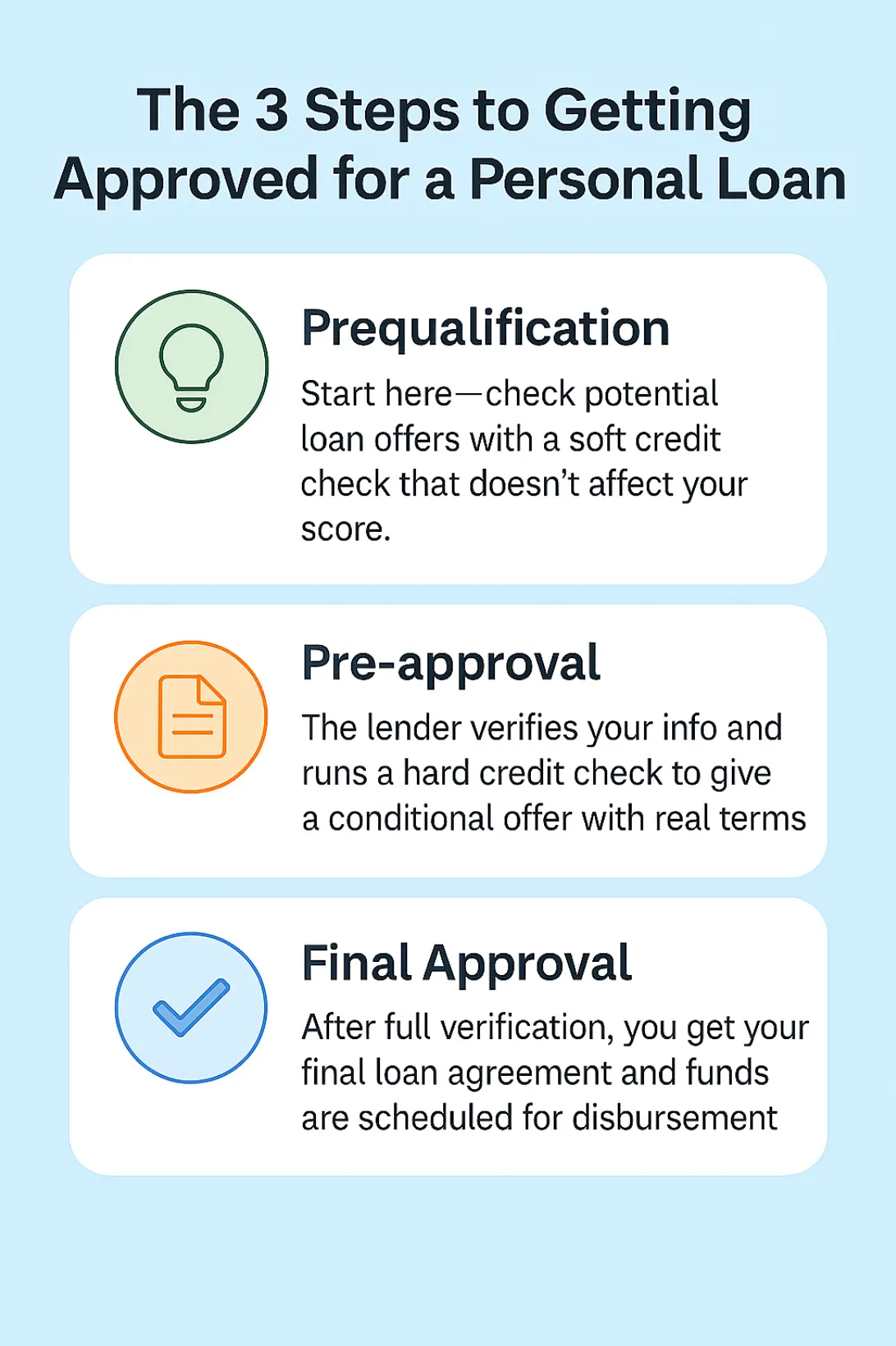
Here’s the sequence your loan process should generally follow:
Shop for lenders: Achieve Personal Loans could be a good place to begin your journey. It's smart to compare at least three lenders to get the full picture.
Prequalification: This step saves you the time and trouble of applying for the loan if the lender doesn't believe your application will make it through underwriting. And when the lender uses a soft pull, there's no impact on your credit score.
Preapproval: Preapproval is your chance to lay it all out for the lender, showing that you can afford and handle the loan.
Final approval: Once you receive final approval, it's time to sign your loan contract and discuss how the proceeds will be disbursed.
What happens after final approval?
Once the lender provides you with a loan contract, you should carefully read it over before signing. Depending on where your lender is located, you may pick up the check in person, have it mailed to you, or have the funds deposited directly into your bank account.
If you’re anxious for the money (and who’s not?), you can do some things that may speed the loan process along. Double-check your loan application before submitting it to ensure all information is correct, and gather any documents you’re likely to need in advance so they’re ready to go when requested.
All that’s left to do is shop for a loan that fits your goals and budget. Once you’ve found the right lender, it’s time to get started on that loan application.
Ready to get started? Check your rates with Achieve Personal Loans without hurting your credit score.
Author Information
Written by
Dana is an Achieve writer. She has been covering breaking financial news for nearly 30 years and is most interested in how financial news impacts everyday people. Dana is a personal loan, insurance, and brokerage expert for The Motley Fool.
Reviewed by
James is a financial editor for Achieve. He has been an editor for The Ascent (The Motley Fool) and was the arts editor at The Valley Advocate newspaper in Western Massachusetts for many years. He holds an MFA from the University of Massachusetts Amherst and an MA from Hollins University. His book Krakatoa Picnic came out in 2017.
Frequently asked questions about prequalification vs. preapproval
Not usually. Most lenders use a soft credit check during the prequalification process, so there’s no impact on your score.
Yes. If key details change, the loan could be denied. Let’s say you go into work the day after applying for a loan and learn that your company is closing. That key change could impact your ability to repay the loan and might lead to a denial of your application.
Preapproval typically lasts 30 to 60 days. If you’re unsure you’re ready to sign, ask the lender how long yours will last.
Related Articles

Adding a co-signer to a personal loan application could improve your approval odds and rate. Learn what lenders look for and how to apply with Achieve.


Learn how unsecured personal loans work, compare rates and terms to credit cards, and find out how to qualify — even with fair credit. Apply today.

Learn how to pay off credit card debt with a personal loan. Compare rates, lower your monthly payments, and get a plan to become debt-free faster.

Adding a co-signer to a personal loan application could improve your approval odds and rate. Learn what lenders look for and how to apply with Achieve.
Learn how unsecured personal loans work, compare rates and terms to credit cards, and find out how to qualify — even with fair credit. Apply today.
Learn how to pay off credit card debt with a personal loan. Compare rates, lower your monthly payments, and get a plan to become debt-free faster.